Skip to main contentSkip to footer
Lana presenting
Brighton & Sussex Medical School

Leadership and Education Fellows with NHSE KSS DEANERY

BSMS > Postgraduate > Continuing Professional Development > Bespoke training and commission > Leadership and Education Fellows with NHSE KSS Deanery

Leadership and Education Fellows with NHSE KSS Deanery

The Leadership and Education Fellows (LEFs) programme aims to enhance the experience and education of the medical workforce, and/or implement service improvements to locally identified priorities, whilst developing the leadership skills of resident doctors.

These prestigious and developmental fellowships, made available through NHS England Kent, Surrey and Sussex (NHSE KSS) Deanery, are specifically designed for career-minded IMT3+ or ST3+ resident doctors with an interest in leadership, medical education and service improvement.  They provide an excellent opportunity to develop leadership skills and experience in these areas, through practical project work and academic study, learning alongside a cohort of peers.  

The programme is managed by Brighton and Sussex Medical School (BSMS), with Fellows completing our post graduate certificate in healthcare leadership and commissioning.   

Participating Trusts from across KSS recruit to the one-year fellowship post, during which the fellow spends the majority of their time leading improvement projects and completing the bespoke development programme. The rest of their time is spent on clinical duties.

Read Luke's story >

See FAQs about the programme here >

A photo of Jessie Cunnett talking on stage about the BSMS LEF programme

BACKGROUND IMAGE FOR PANEL

Outcomes from previous leadership and education fellows

Over the period 2017 to 2025, fellows from Trusts across KSS have undertaken a wide range of projects to address local challenges and support organisational, regional and national priorities. At the end of each year, fellows present posters showcasing their work and learning.  

Collectively, these projects have delivered improvements across four broad themes:

Enhancing local education delivery projects introduced innovative learning opportunities, including simulation training, in-situ leadership sessions, learning from Serious Untoward Incidents, and immersive Virtual Reality (VR) resources. They also improved the quality and accessibility of training through enhanced induction programmes, point-of-care teaching, strengthened specialty training, and the effective use of online learning. GMC trainee survey findings were used to identify and implement targeted improvements to local education.

Improving the local experience of resident doctors focused on strengthening wellbeing and engagement. Outcomes included the establishment of sustainable wellbeing services, greater resident involvement in rota design and service improvement, a new appraisal process for Locally Employed Doctors, and support for staff during a hospital transition.

Service and quality improvement projects delivered changes to clinical pathways, patient care and service delivery. Key outcomes included a pre-optimisation pathway for elective patients, a collaborative perioperative smoking cessation initiative, improvements to induction of labour, sustainability projects in anaesthetics, and quality improvement work within mental health services.

Supporting International Medical Graduates (IMGs) centred on improving educational, professional and pastoral support. Projects developed tailored training programmes, explored IMG experiences, improved induction and orientation to the NHS and local roles, and produced recommendations to strengthen supervision and support arrangements.
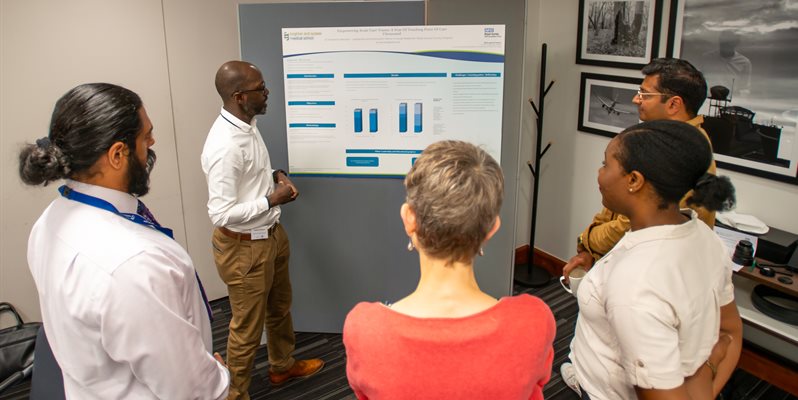
LEF students at BSMS presenting posters to a group

Personal and professional development

A thematic review of the 2025 posters identified the impact of the programme on fellows’ learning and development.  Fellows developed their ability to lead with authenticity, navigate complexity, and influence others while promoting medical education through resource creation, teaching, and scholarship. They gained hands-on experience in managing change, applying project and quality improvement tools, and sustaining progress in resource-constrained environments. 

The programme also fostered strong collaborations, networking, and peer support, while deepening understanding of the NHS, patient experience, and health inequalities. Importantly, it encouraged adaptability and innovation, with fellows exploring digital solutions, new modes of working, and data-driven approaches to shape the future of healthcare. 

Together, these outcomes demonstrate the fellowship’s ongoing value in developing leaders who can deliver meaningful change in healthcare systems.

100% of evaluation survey respondents would recommend the programme to others:

  • “Absolutely superb programme… Helpful, insightful journey…”
  • “The programme was a leap in my development.” 
  • “I feel very priviledged to have been able to take part in the programme. I have developed personally and professionally… I feel that I have been able to have an impact that will continue for some time to come.”
  • “I’ve really appreciated the time to take a step back and focus on the bigger picture, diving into how the NHS functions operationally and giving me a confidence into how to effect positive change going forward” 

Lasting impact

In a 2025 survey of fellow alumni, respondents consistently described the experience as transformative, with benefits extending well beyond the fellowship year.   

“It furnished me with the skills to navigate change management in particular, which I use time and again to facilitate change in my roles for the last 5 years or so.” 

To find out more about the programme design and impact, see our brochure.

View our LEF brochure here >

Martina presenting

A group of people at an event standing around having a conversation

Development Programme 

The Leadership and Education Fellows are supported by a comprehensive education and development package, delivered and designed and delivered specifically for the programme by BSMS.

By the end of the development programme, fellows will have:

  • Attained a deep knowledge and understanding of leadership, education and service improvement in the healthcare setting
  • Developed their skills in applying their learning to real issues identified as priorities in their Trust
  • Completed post-graduate certificate studies in Healthcare Leadership and Commissioning
  • Made a significant contribution to improving the local education and experience of the medical workforce.

Visit the course page below to find out more about the PGCert in Healthcare Leadership and Commissioning.

PGCert in Healthcare Leadership and Commissioning