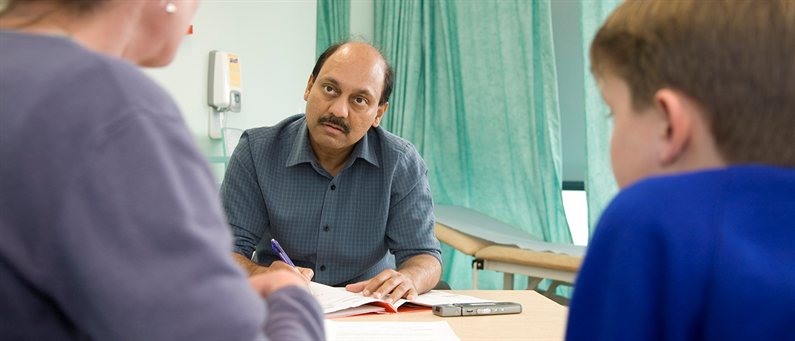
Our internationally recognised research into childhood asthma and allergy has brought significant progress within a short space of time from the exploration of new mechanisms in children's asthma and allergy to benefits for patients.
Professor Mukhopadhyay’s previous work has shown that common asthma reliever drugs taken by millions of children around the world may worsen asthma control in children with a particular genetic make-up. Subsequently, he has led randomised controlled trials which have demonstrated that prescribing that takes account of genetic characteristics of children leads to improved asthma-related quality of life. This has already influenced healthcare guidance, e.g. in Australia, and spurred similar trials in other countries such as The Netherlands. While such applications of personalised medicine could revolutionise treatments, there are many challenges to their implementation in routine care. A research programme, driven by several PhD students and funded in part by the NHS, seeks to identify and tackle these challenges within healthcare, so that the goal of bringing benefits to children and families can be better achieved.
The research team has also discovered other pathways contributing to asthma and allergy in children, which hold further promise of developing new interventions. For example, the discovery of the link between skin barrier-related gene defects and childhood atopy and asthma has led to much work on understanding how asthma and allergy develops, and the search for novel therapies.
The work is also generating studies of similar approaches to benefit children with other conditions, such as cerebral palsy, autism and ADHD.
The paediatric research team is based across Sussex, including the Royal Alexandra Children's Hospital in Brighton and Chailey.