Magnetic Resonance Imaging (MRI) has transformed modern healthcare, underpinning diagnosis, monitoring and treatment across neurology, oncology, cardiology and mental health. Yet access to this vital technology remains deeply unequal. Across much of Africa and other low- and middle-income countries (LMICs), limited access to MRI not only affects patient care but also restricts research, innovation and global collaboration in one of the most rapidly advancing areas of biomedical science.
At Brighton and Sussex Medical School (BSMS), Dr Iris Asllani, Associate Professor and Head of MRI Physics at the Department of Clinical Neuroscience, is working to address this imbalance. Part of the Consortium for the Advancement of MRI Research and Education in Africa (CAMERA) from its earliest stages, Dr Asllani serves as Vice Chair and Chair of CAMERA’s Advisory Board. CAMERA was founded and is chaired by Udunna Anazodo, a Nigerian-Canadian faculty member at McGill University, whose leadership has shaped the consortium since its inception. Dr Asllani’s work focuses on building sustainable MRI capacity across Africa through education, training, mentorship, and international collaboration.
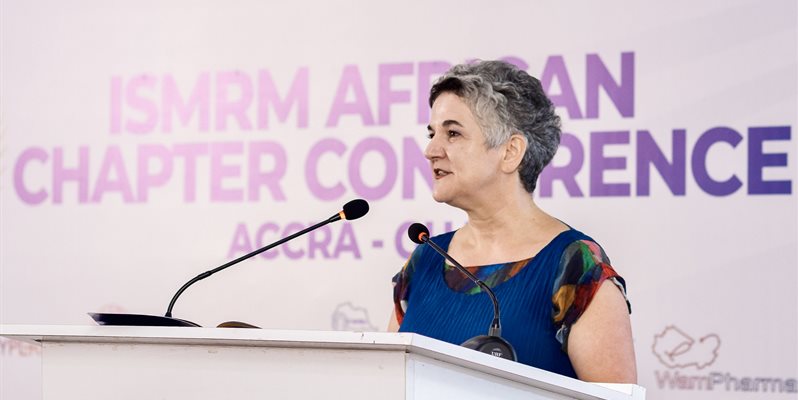
Dr Iris Asllani, Associate Professor and Head of MRI Physics at the Department of Clinical Neuroscience at BSMS
A personal journey shaping a global mission
Dr Asllani’s commitment to equitable access in medical imaging is rooted in personal experience. More than 30 years ago, she was awarded a Fulbright scholarship to pursue biomedical imaging research at the Fred Hutchinson Cancer Research Center in the United States. At the time, Albania had only just established diplomatic relations with the US, and Dr Asllani became the first Albanian citizen to receive a US visa.
“That opportunity left me with a lasting sense of responsibility about who gets access to education and technology, and who is left behind,” she says.
This sense of purpose was reinforced recently at Africa’s first MRI-focused conference in Accra, Ghana. The experience echoed memories of her childhood in Tirana, highlighting how structural barriers continue to shape access and opportunity across different contexts.
Building MRI capacity through CAMERA
Founded to address the lack of MRI access and representation across Africa, CAMERA is a global network working to build sustainable MRI education and research capacity. Its activities have already led to significant change, including the establishment of the African Chapter of the International Society for Magnetic Resonance in Medicine (ISMRM) in 2023, ensuring African researchers are represented within a major international professional body.
One of CAMERA’s earliest initiatives was a continent-wide needs assessment, led by Udunna Anazodo, and published as “Bringing MRI to low- and middle-income countries: Directions, challenges and potential solutions.” The study provided an evidence-based foundation for action, identifying barriers and opportunities across diverse healthcare systems.
CAMERA has also secured funding from the Chan Zuckerberg Initiative to launch SMARTA, a spin-off organisation operating in Africa with a strong local focus on MRI education and training. SMARTA is led by Professor Godwin Ogbole at the University of Ibadan, Nigeria, and works closely with hospitals and universities across the continent.
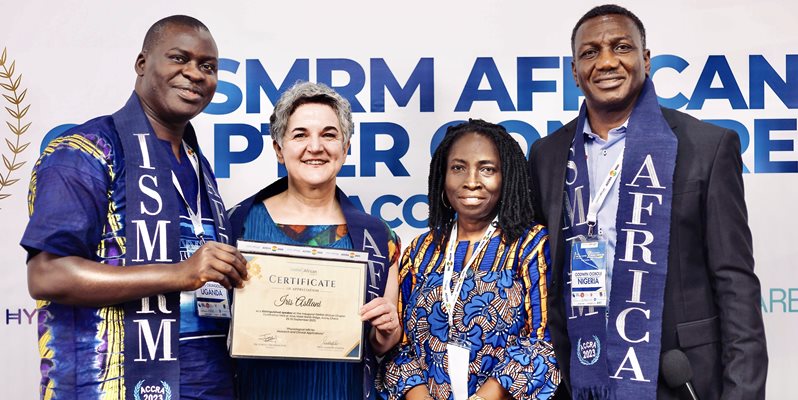
Dr Asllani receiving a certificate at the ISMRM African Chapter with Johnes Obungoloch from Uganda (President of the Chapter), Godwin Ogbole (Head of Radiology, University of Ibadan, Nigeria), and Professor Klenam Dzefi-Tettey, the first female Associate Professor of Radiology in Ghana
Innovation, training and public engagement
In addition to technical training, CAMERA places strong emphasis on advocacy and public engagement. In 2024, together with SMARTA, the consortium organised The Art of African MRI (TAAM) in Tanzania, bringing together researchers, policymakers and representatives from the diplomatic community. In collaboration with Dar es Salaam–based fashion designer Isagus Toche, MRI images were incorporated into wearable designs modelled by African scientists themselves, creating a powerful platform for dialogue about healthcare access and equity beyond academic settings.
Capacity building remains central to CAMERA’s mission. In September, a hands-on workshop on Arterial Spin Labelling (ASL) perfusion MRI was held in Lagos, Nigeria, led locally by Professor Ogbole and involving hospitals across the region. Researchers and clinicians from Africa, Europe, Asia and the United States worked together to establish harmonised protocols on existing scanners, enabling advanced MRI methods to be implemented using available resources.
Reflecting on the workshop, Dr Asllani describes a moment that captured the ethos of CAMERA’s work: stepping into the scanner herself while trainees learned to acquire ASL images.
“When we reviewed the images together, it was a reminder that when you look inside the brain, no one can tell the colour of your skin,” she says.
Aligning with BSMS’s global mission
CAMERA’s work aligns closely with BSMS’s commitment to global health, inclusive research and international collaboration. It complements wider activity across neuroscience and global health at BSMS and the University of Sussex, including work by colleagues engaged in international training and capacity building.
As CAMERA continues to grow, its focus is shifting from initiative to institution, supported by independent funding, open-access resources and formalised governance structures. While challenges remain, the trajectory is clear: CAMERA is reshaping how MRI education, innovation and collaboration can be pursued globally, even in resource-limited settings.
Dr Asllani emphasises that sustained engagement is key. “This isn’t about one-off interventions,” she says. “It’s about building communities, sharing expertise and ensuring that those closest to the challenges are central to shaping solutions.”
This work sits within a wider framework of global engagement, with relevance beyond Africa. In my role on the board of Albania’s National Institute of Physics, I am exploring how the CAMERA model can be adapted to strengthen education and training in Albania and in other countries where access to advanced clinical imaging remains a challenge.
Get involved
To learn more about CAMERA’s work visit the CAMERA website. To explore accomplishment of 2025, read the Annual Report. CAMERA is also keen to connect with volunteers passionate about neuroscience, neuroimaging and global engagement. Those interested in contributing are encouraged to get in touch via the CAMERA website or contact Dr Asllani directly.
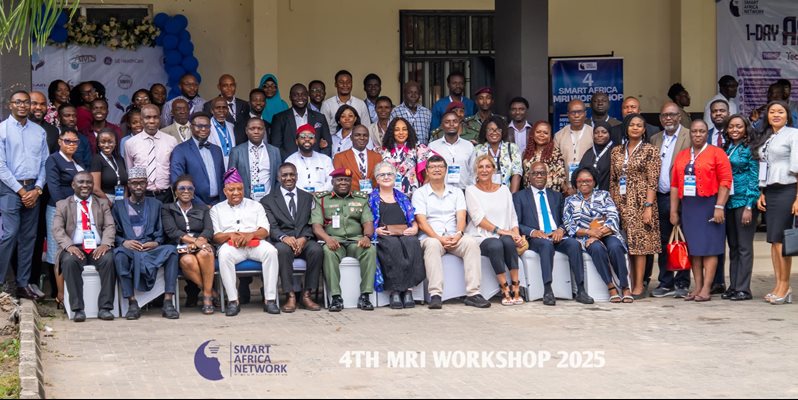 Attendees at the 4th MRI Workshop in 2025